

YouTube Automation: The Complete Guide to Faceless Cash Cow Channels (2026)
YouTube automation is one of the most searched business models online right now — and for good reason. Thousands of channels generate five and six figures a month without a single on-camera presenter, without a personal brand attached, and without the creator doing most of the work themselves. This guide breaks down exactly how YouTube automation works, what a faceless cash cow channel actually is, what you need to build one, and where most people stall out before they ever get momentum.
If you’re building or scaling a faceless YouTube channel and want the video production side handled professionally, WREDD’s YouTube automation service is built for exactly that.
What Is YouTube Automation?
YouTube automation is the practice of running a YouTube channel as a business — where the content creation process is systematised and delegated rather than handled personally by the channel owner.
The channel owner focuses on strategy, niche selection, and monetisation. Everything else — scripting, voiceover, video editing, thumbnails, SEO, scheduling — is handled by a team or a production partner.
The result is a channel that publishes consistently and grows without requiring the owner to appear on camera, record their own voice, or spend hours in editing software every week.
This is not a loophole. It’s a production model. The same model newspapers, media companies, and TV studios have used for decades — applied to YouTube.
The three things that make YouTube automation viable as a business:
- YouTube’s ad revenue model (AdSense) pays per thousand views, meaning a well-optimised channel in a high-CPM niche generates passive income from its back catalogue indefinitely
- Faceless content scales — you’re not limited by how much time you personally have on camera
- Outsourcing is mature — the talent ecosystem for scriptwriters, voiceover artists, video editors, and thumbnail designers is large, accessible, and increasingly specialised.
What Is a Faceless YouTube Channel?
A faceless YouTube channel is a channel where no individual host, presenter, or personality appears on screen. The content stands entirely on its visuals, narration, and editing.
Most people assume YouTube requires a personal brand — a face, a name, a personality to follow. The data says otherwise. Some of the highest-earning channels on the platform show no face at all. Finance explainers. Documentary-style narration. Top 10 lists. AI-generated visuals. Animated educational content. Compilation channels. All faceless. All monetised.
The advantage for channel owners is significant:
- No personal brand exposure — the channel is an asset, not an identity. It can be sold.
- No camera, no studio, no lighting setup — the barrier to entry is lower
- Scalable — run multiple channels simultaneously without spreading yourself across different on-camera commitments
- Sellable — a faceless channel has a market value independent of its creator; a personal brand channel does not
The disadvantage is that faceless content lives and dies on production quality. Without a personality carrying the video, the scripting, voiceover, pacing, and visuals have to do the work. Mediocre production on a faceless channel is a dead channel.
What Is a Cash Cow YouTube Channel?
A cash cow channel is a specific model of faceless YouTube automation — one engineered from the ground up to maximise AdSense revenue per view.
The name comes from the business strategy concept: a cash cow is an asset that generates steady, high-margin returns with relatively low ongoing input. Applied to YouTube, it means a channel in a high-CPM niche, publishing consistently, optimised for watch time and click-through rate, with production costs kept efficient enough that the margin between AdSense revenue and production spend is significant.
The typical cash cow channel has these characteristics:
- High-CPM niche — finance, business, insurance, real estate, legal, health, technology. These niches attract advertisers willing to pay $10–$40+ per thousand views, versus $1–$3 in entertainment or gaming
- Evergreen content — topics that stay relevant for months or years, meaning older videos keep generating views and revenue without requiring updates
- Consistent upload schedule — the YouTube algorithm rewards channels that publish regularly; cash cow operators typically target 3–5 videos per week
- Optimised titles and thumbnails — click-through rate is everything; a well-optimised thumbnail on a high-impression video can be the difference between 50,000 views and 500,000
- Delegated production — the economics only work when production cost per video is controlled; this means a tight, repeatable workflow
The cash cow model is not passive at launch. Building it requires upfront investment in niche research, channel positioning, and production infrastructure. But once the system is running and a channel reaches monetisation threshold (1,000 subscribers and 4,000 watch hours), the income curve becomes increasingly favourable over time.
The Full YouTube Automation Workflow
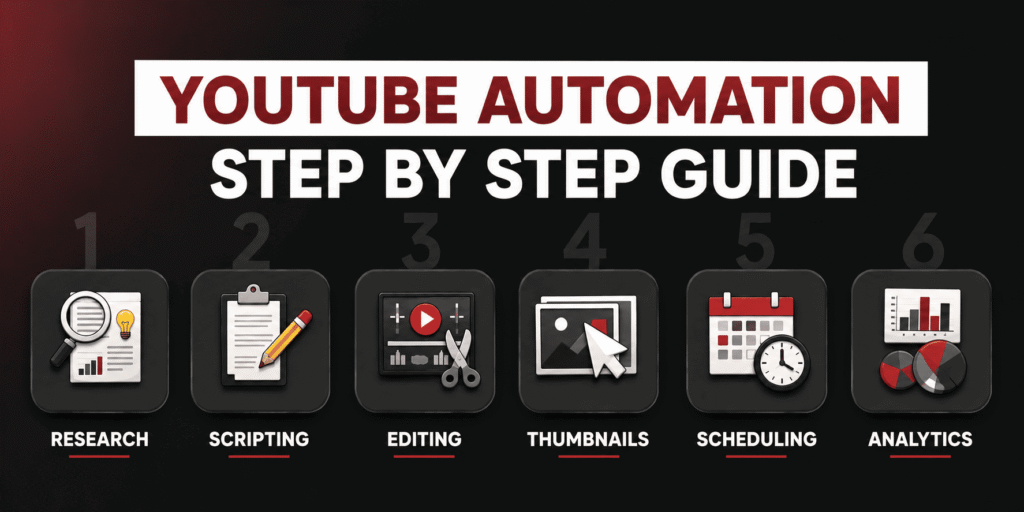
Running a YouTube automation channel means managing a production pipeline. Here is what the full workflow looks like end to end:
1. Niche and keyword research. Everything starts here. The niche determines your CPM ceiling, your competition level, and your content strategy. High-CPM niches are competitive — the keyword research has to be precise. You’re looking for topics with meaningful search volume and manageable competition, inside a niche where advertisers pay well.
2. Scripting. A faceless channel’s script carries more weight than almost any other production element. It has to hold attention for 8–15 minutes without a personality on screen, hit the right pacing, and be structured to maximise watch time retention. Good scriptwriters who understand YouTube specifically — not just content writing — are worth finding and keeping.
3. Voiceover. The narration style sets the tone of the entire channel. Some operators use professional human voiceover artists; others use high-quality AI voice tools. Both can work. Human VO generally performs better on retention for longer-form content; AI VO is faster and cheaper for high-volume schedules. The choice depends on niche, audience, and budget.
4. Video production. This is where most automation channels stall. Stock footage, B-roll, motion graphics, text overlays, transitions — all of it needs to be assembled into a video that holds viewer attention for its full duration. For animated content specifically, this is where a production partner like WREDD’s YouTube automation service replaces an entire in-house editing function.
5. Thumbnail design. Thumbnails are the most tested, most iterated element of any serious YouTube channel. CTR (click-through rate) directly determines how aggressively YouTube distributes your video. A channel with a 6% CTR gets dramatically more algorithmic push than one at 3%. Thumbnails are not cosmetic — they are the primary distribution lever.
6. Title and SEO. YouTube is a search engine. Title structure, description keywords, tags, and chapter markers all affect discoverability. The script keyword strategy and the YouTube SEO strategy need to be built together, not treated as separate disciplines.
7. Scheduling and consistency. YouTube rewards channels that publish on a reliable cadence. The algorithm weights consistency — a channel that drops five videos in a week and then goes quiet for three weeks does not benefit the way a channel publishing three videos a week on a fixed schedule does.
Why Most YouTube Automation Channels Fail?
The model is real. The income potential is real. But most people who attempt YouTube automation do not reach monetisation — and the reasons are consistent.
They underinvest in production. Faceless channels live on quality. A video that looks cheap, sounds flat, or loses viewer attention at the two-minute mark does not recover. YouTube’s algorithm measures watch time percentage — a video that retains 60% of viewers to the end is rewarded; one that loses half its audience in the first three minutes is suppressed. Production quality is not optional; it’s the mechanism.
They pick the wrong niche. High-CPM niches are competitive. Picking a finance or business niche without doing thorough keyword research means competing against established channels with hundreds of thousands of subscribers on broad keywords where you have no realistic path to ranking. Niche selection is a research problem, not a gut-feel decision.
They stop too early. YouTube automation is not fast. Most channels need 50–100 videos before the algorithm has enough data to distribute them at scale. Operators who expect income in the first two months almost always quit before the channel has had time to compound. The ones who succeed treat it as a 12–18 month build, not a 60-day experiment.
They try to do everything themselves. The automation model only works when the production is actually delegated. Channel owners who script, voice, edit, design thumbnails, and handle SEO themselves are not running an automated channel — they’re freelancing for their own YouTube page. The system requires a team or a production partner.
What WREDD Handles for YouTube Automation Channels?
WREDD’s YouTube automation service covers the production side of the pipeline — the part most channel owners struggle to scale without sacrificing quality.
What WREDD produces for automation channels:
- Fully animated videos — 2D and motion graphics production built for YouTube’s retention requirements; no stock footage dependency
- Custom scripting — written for YouTube pacing and watch-time optimisation, not generic content
- Professional voiceover — human VO in US and UK English, matched to niche and audience
- Thumbnails — designed for CTR, tested against YouTube best practices, brand-consistent across the channel
- Consistent output — production schedules that support 3–5 uploads per week without quality drop
The model works for operators building from scratch and for existing channels looking to scale volume or upgrade production quality. WREDD works with channel owners across the US, UK, UAE, and Europe — across finance, business, technology, education, and other high-CPM niches.
Every new client starts with a free video sample. You see the production quality, the scripting style, and the visual approach before committing to a production schedule. If it’s the right fit, we build from there. If it’s not, you’ve lost nothing.
The YouTube automation service page has the full breakdown of what’s included and how the engagement works.
How to Start a YouTube Automation Channel in 2026?
If you’re starting from zero, here is the sequence that works:
Step 1 — Pick your niche with data. Use YouTube search, TubeBuddy, or VidIQ to identify high-CPM topics with achievable competition levels. Don’t pick a niche because you find it interesting. Pick it because the numbers work.
Step 2 — Study the top channels in that niche. Watch their highest-performing videos. Note the title structure, the thumbnail style, the video length, the scripting pace. You’re reverse-engineering what already works before you spend any production budget.
Step 3 — Build your production system before you publish. Know who is scripting, who is handling voiceover, and who is editing before your first video goes live. A channel that publishes two videos and then goes quiet for six weeks while the owner figures out their workflow has already damaged its algorithmic standing.
Step 4 — Publish consistently for 90 days before evaluating. The first 90 days are data collection. You’re learning which topics get traction, which thumbnails get clicked, which video lengths retain your audience. Make decisions based on that data — not on gut feel after three videos.
Step 5 — Reinvest early revenue into production quality. Once AdSense kicks in, the first priority is improving the weakest element of your production pipeline. Better thumbnails. Better scripting. Better voiceover. The compounding effect of improved retention and CTR is worth more than early withdrawals.
Ready to Automate Your YouTube Channel?
Get a free video sample from WREDD — see the production quality before you commit to a single video. No obligation. No invoice until you’ve seen exactly what you’d be getting.
Ready to automate your YouTube channel? Get a free video sample from WREDD →