

Book Trailers: The Complete Guide for Authors and Publishers (2025)
You spent years writing your book. You’ve poured your story onto the page, revised it countless times, and finally held the finished product in your hands. Now comes the part most authors dread: getting people to actually pick it up.
In a world where readers scroll through hundreds of titles a day, a static cover image and a blurb often aren’t enough. This is where book trailers come in: and if you’re an author or publisher who hasn’t explored them yet, you’re sitting on one of the most powerful and underused marketing tools in publishing today.
What Is a Book Trailer?
A book trailer is a short video: typically 60 to 120 seconds: that promotes a book the same way a movie trailer promotes a film. It blends visuals, music, voiceover, and text to capture the mood and premise of your book and invite viewers to want more.
Just as a great movie trailer doesn’t reveal the ending, a great book trailer doesn’t summarize the plot. It sells a feeling. It creates anticipation. It gives potential readers a reason to click “Buy Now.”
The format has evolved significantly over the past decade. Early book trailers were often clunky slideshow-style videos with royalty-free stock photos and generic music. Today, the best ones: including the animated book trailer service used by authors and publishers across the globe: are sleek, cinematic, and emotionally resonant.
Types of Book Trailers
Not all book trailers are created equal. Depending on your book’s genre, target audience, and budget, different styles will serve you better. Here’s a breakdown of the main types:
1. Animated Book Trailers
Animation is arguably the most versatile format for book trailers. Whether your book is a fantasy epic, a children’s picture book, a thriller, or a business guide, animation can bring it to life without the limitations of live-action filming. Animated trailers allow for complete creative control: every visual element is designed specifically for your book’s world and tone.
This style is particularly popular with fiction authors because it lets you portray fantastical worlds, characters, and scenes that would be impossible or prohibitively expensive to film. It’s also the format most recommended by professional trailer producers for authors who want something distinctive that stands out from the crowd.
2. Live-Action Book Trailers
Live-action trailers feature real actors, locations, and cinematography. They work well for contemporary fiction, memoirs, and narrative non-fiction where real-world imagery is a natural fit. The downside is cost and logistics: hiring actors, location scouting, and professional filming can quickly drive up the budget.
3. Motion Graphics / Kinetic Typography Trailers
This style relies on animated text, shapes, and transitions rather than illustrations or film footage. It’s clean, modern, and highly effective for non-fiction books, self-help titles, and business books. The focus is on delivering key messages and ideas in a visually dynamic way.
4. Slideshow / Photo Montage Trailers
The simplest and most affordable option, slideshow trailers use a sequence of still images: often licensed stock photos: set to music and text overlays. While the production bar is low, so is the impact. In competitive categories, a slideshow trailer rarely makes the impression that an animated or live-action one does.
5. Author Interview / Documentary Style
Some authors go a different route and create a short documentary-style video where they speak directly to camera about their book. This can be powerful for building an author brand and creating a personal connection with readers, especially when combined with a more polished trailer.
What Makes a Book Trailer Effective?
Plenty of book trailers exist. Few of them are truly effective. Here’s what separates the ones that drive sales from the ones that fade into obscurity.
A Clear Emotional Hook in the First Five Seconds
Viewers decide within seconds whether to keep watching. Your trailer needs to open with something that creates immediate curiosity, tension, or emotional resonance. A compelling question, a striking visual, or a powerful line of dialogue can all do the job: but it must happen fast.
Tone That Matches the Book
A mismatch between your trailer’s tone and your book’s actual content is one of the most common mistakes authors make. A cozy mystery trailer that feels intense and dark will attract the wrong readers: and disappoint them when they buy the book. Your trailer should be a promise to the reader about the experience they’re going to have.
Professional-Quality Visuals and Sound
Poor audio kills a trailer faster than anything else. Even if your visuals are beautiful, crackling audio or a generic free music track signals low quality and makes viewers less likely to trust that your book is worth their time. Professional production: whether you’re using an animated book trailer service or a live-action crew: pays for itself in credibility alone.
A Clear Call to Action
What do you want viewers to do after watching? Tell them. “Available now on Amazon.” “Pre-order today.” “Visit authorname.com.” Without a clear call to action, you’ve created entertainment: not marketing.
Optimal Length
Most data supports keeping book trailers between 60 and 90 seconds. Under 30 seconds rarely gives you enough time to build emotional investment. Over two minutes starts to feel like a pitch rather than a tease. The sweet spot is just long enough to hook the viewer and leave them wanting more.
The Book Trailer Production Process
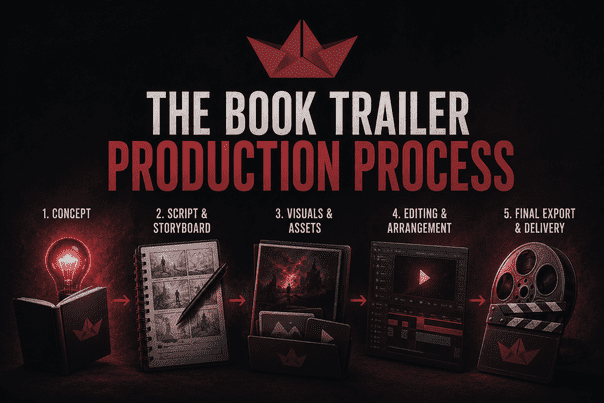
If you’ve decided a book trailer is right for your marketing strategy, here’s what the production process typically looks like when working with a professional team.
Step 1: Brief and Discovery
The first step is always a deep dive into your book. A good production team will want to understand your genre, target audience, key themes, tone, comparable titles, and your goals for the trailer. Where will it be shared? What platforms? Who is the ideal viewer?
This stage often includes a questionnaire or discovery call. The more information you provide here, the better the final product will align with your vision.
Step 2: Concept Development
The creative team develops a concept or several concept options for your trailer. This includes the narrative approach (what will the trailer show?), the visual style (illustrated, typographic, cinematic?), the music direction, and the overall mood.
For animated trailers, this stage may include mood boards or style references to help you visualize the direction before a single frame is created.
Step 3: Scripting and Storyboarding
Once a concept is approved, the team writes the script: the combination of voiceover, on-screen text, and visual descriptions that map out the trailer beat by beat. This is then translated into a storyboard, which shows the sequence of scenes and how they’ll unfold visually.
Storyboard approval is your opportunity to catch anything that doesn’t feel right before the expensive production work begins.
Step 4: Production
This is where the trailer actually comes to life. For animation, this means character design, scene illustration, and motion work. For live-action, it means filming days. For motion graphics, it means building out the visual sequences in post-production software.
This is typically the most time-intensive phase, and timelines can vary from one week to several weeks depending on the complexity of the project.
Step 5: Sound Design and Music
A skilled sound designer will source or compose music that matches the tone you’re going for and layer in any sound effects that enhance the atmosphere. If your trailer includes voiceover, this is recorded and refined in this stage as well.
Step 6: Revisions and Final Delivery
After reviewing the initial cut, you’ll typically have one or two rounds of revisions to fine-tune timing, text, music levels, or visual elements. Once approved, you receive your final files in the formats you need: typically optimized for YouTube, social media, and website embedding.
Where to Use Your Book Trailer
Once you have your trailer, use it everywhere:
- Amazon Author Page: Amazon allows you to embed a video on your author profile, putting your trailer in front of buyers already browsing your genre.
- YouTube: Create a channel for your author brand and upload your trailer as its own video, optimized with searchable keywords.
- Social Media: Trailers perform exceptionally well on Instagram Reels, TikTok, and Facebook. Short clips from your trailer can serve as teasers.
- Your Website: Embed the trailer prominently on your book’s landing page.
- Email Newsletter: Share the trailer with your mailing list around your launch date.
- Press Kits: Include a link to your trailer in any press or media outreach.
- BookTok and Bookstagram: If your book’s audience is active on these platforms, a well-crafted trailer clip can go genuinely viral.
Typical Book Trailer Costs
Book trailer pricing varies depending on the complexity, length, and production quality you need. Here’s a breakdown of WREDD’s current animated book trailer service packages:
| Package | Price | Best For |
|---|---|---|
| Book Overview | $100 per video | Amazon listings, Goodreads, and social media |
| Story Trailer | $250 per video | Serious book launches |
| Series & Premium | $450 per video | Series reveals, box sets, and publishing house campaigns |
Book Overview ($100) — Up to 60 seconds, includes 3D book cover animation, 5 quotes or captions, background music, 2 revision rounds, and MP4 delivery in 3 days.
Story Trailer ($250) — 60 to 90 seconds of full cinematic animation with custom character visuals, professional voice narration, dramatic music and sound design, unlimited revisions, and MP4 delivery in 5 to 7 days.
Series & Premium ($450) — Up to 2 minutes of full cinematic 3D production covering multiple covers or volumes, professional voice narration, custom music composition, unlimited revisions, and MP4 plus a social media cut delivered in 7 to 10 days.
It’s worth noting that a single well-executed trailer can be repurposed across years of marketing efforts. Unlike a paid ad that stops delivering the moment you stop paying, a strong trailer has an indefinitely long shelf life. When viewed through that lens, even the premium package is a remarkably cost-effective investment.
Is a Book Trailer Worth It?
For the right book and the right author, absolutely. The authors who see the strongest return from book trailers tend to share a few characteristics: they have a clear target audience, they’re active on at least one platform where video content performs well, and they use the trailer as part of a broader launch strategy rather than a standalone effort.
Book trailers are not magic. They won’t compensate for a weak book or an absent marketing strategy. But as one element of a well-planned campaign, a professional trailer: especially a distinctive animated one: can meaningfully increase visibility, social sharing, and ultimately sales.
If you’re ready to take your book’s marketing to the next level, explore what a professionally crafted animated book trailer service can do for your next release.
Looking to get started? WREDD specializes in high-quality animated book trailers for authors and publishers. Reach out to discuss your project today.