

2D vs 3D Animation for Business: Cost, Use Cases, and Which Is Right for You (2026)
Choosing between 2D and 3D animation for a business project is not a creative preference — it’s a commercial decision. The format you choose affects your production budget, your timeline, your revision flexibility, and whether the final video actually performs the job it was built for. Get it right and you have an asset that earns its cost back many times over. Get it wrong and you’ve spent real money on a video that sits unused because it doesn’t fit the context it was made for.
This guide cuts through the noise. Real cost figures. Industry-specific use cases. A clear decision framework. And no vague creative advice about which “feels” better for your brand.
If you already know which format you need and want to see what production looks like, start with WREDD’s SaaS explainer video page or get in touch for a free sample.
What the Two Formats Actually Are
Before comparing them, it’s worth being precise about what each format involves — because the cost and timeline differences flow directly from the production process.
2D animation is motion created on a two-dimensional plane. Characters, graphics, and elements are illustrated and animated frame by frame or using rigged motion. The production pipeline is: concept → script → storyboard → illustration → animation → voiceover → sound design → final export. It’s fast to iterate, relatively straightforward to revise at any stage, and the output can range from minimal and corporate to richly illustrated and character-driven.
3D animation adds a third dimension. Objects are built as digital models with geometry, texture, and physical properties — then placed in a virtual environment with lighting, camera angles, and rendering. The pipeline is longer: concept → script → modelling → rigging → texturing → lighting → animation → rendering → compositing → voiceover → sound design → final export. Rendering alone — the process of the software calculating every frame — can take hours per second of finished video. Revisions mid-production are significantly more costly than in 2D because changing a model, a texture, or a lighting setup can require re-rendering large portions of the video.
Understanding this difference explains almost every cost and timeline gap between the two formats.
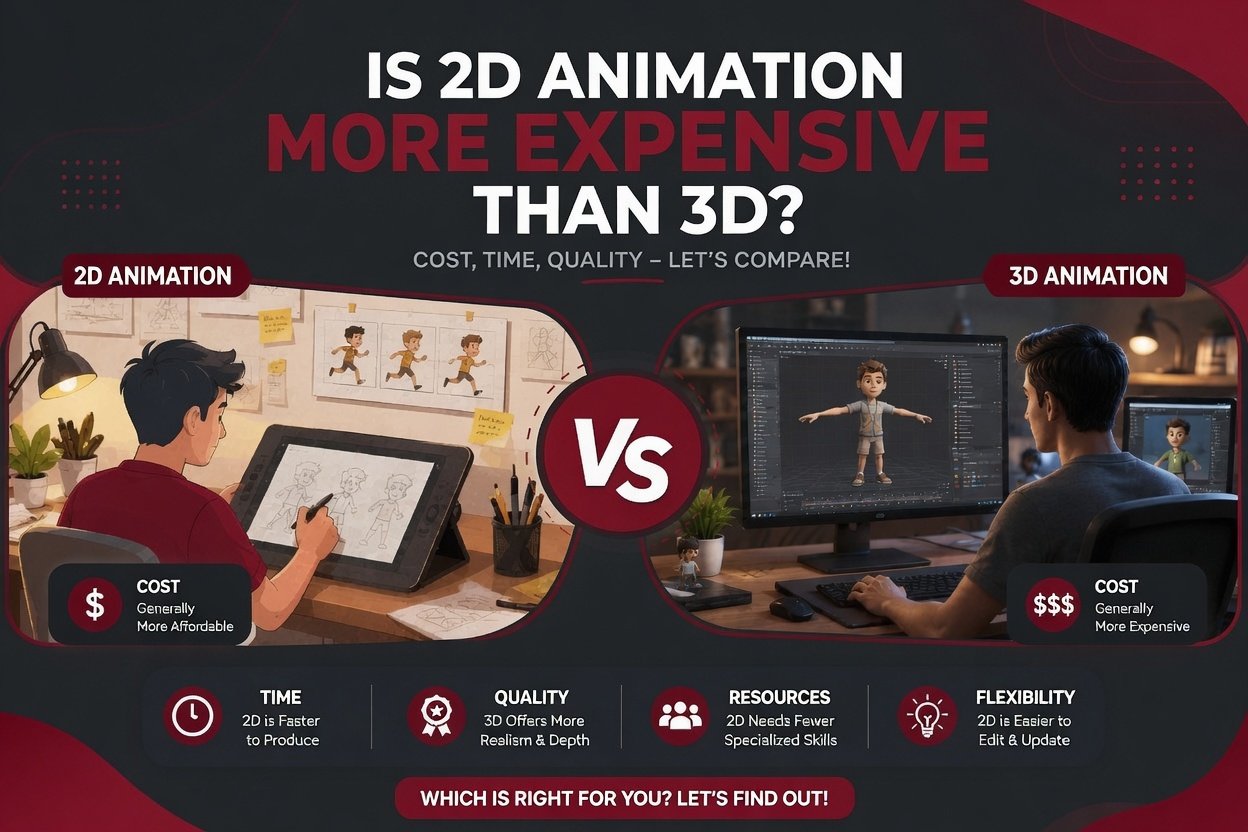
2D vs 3D Animation Cost for Business: Real Numbers
Cost ranges vary by studio, region, and project scope — but the following figures reflect professional custom production at a studio level, not freelance marketplaces or template tools.
| Factor | 2D Animation | 3D Animation |
|---|---|---|
| Entry-level (60 sec) | From ~$800–$1,500 | From ~$1,500–$3,000 |
| Mid-range (60–90 sec) | $2,000–$6,000 | $4,000–$12,000 |
| Premium / enterprise | $6,000–$15,000+ | $12,000–$40,000+ |
| Production time | 2–3 weeks | 3–6 weeks |
| Revision cost | Lower — changes are faster | Higher — renders affected |
| Multi-format cuts | Efficient to repurpose | More costly per additional cut |
The cost gap between 2D and 3D at comparable quality levels is typically 2–3×. This is not markup — it reflects the genuine difference in hours, software, rendering infrastructure, and specialist skill required.
For businesses making a format decision on budget grounds alone: 2D gives you more production quality per dollar in almost every scenario where the brief doesn’t specifically require dimensional realism. The question is always whether the brief requires 3D — not whether 3D is generally better.
2D Animation for Business: Where It Works
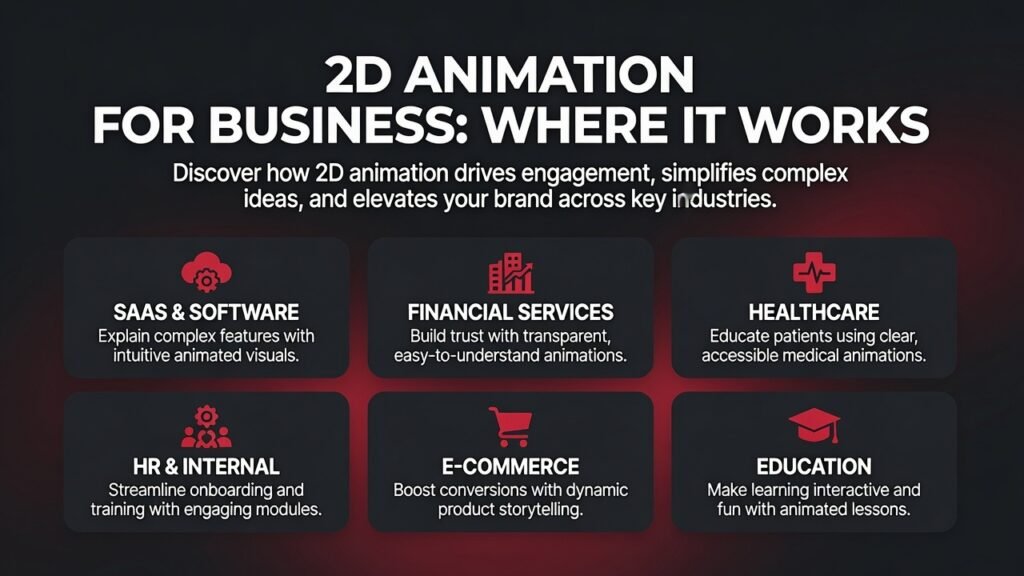
2D animation is the dominant format for business video production globally, across almost every sector. It’s not the budget fallback — it’s the most commercially versatile format available.
SaaS and software companies. Product explainers, onboarding videos, feature announcements, sales enablement content. 2D handles UI demonstration, process flows, and abstract concepts (data, integrations, automation) better than 3D because it can simplify and clarify without trying to look photorealistic. See WREDD’s SaaS explainer video production for how this works in practice.
Financial services and insurance. Complex products — investment vehicles, insurance policies, mortgage processes — need to be made understandable without visual noise. Motion graphics and 2D character animation communicate financial concepts clearly, professionally, and with appropriate brand weight.
Healthcare and medical. Patient education, clinical trial explainers, medical device demonstrations. 2D handles anatomical illustration and process diagrams well, and is faster to update when content needs to change — which it frequently does in regulated industries.
HR and internal communications. Training videos, compliance content, onboarding programmes. 2D is cost-efficient at volume, easy to localise (swap voiceover and text overlays for different markets), and flexible enough to match varied brand guidelines.
E-commerce and consumer brands. Product explainers for online retail, brand story videos, social content. 2D works across every format and aspect ratio with minimal production overhead per additional cut.
Education and e-learning. Curriculum content, explainer series, course materials. 2D animation at volume is financially viable for content libraries in a way that 3D rarely is.
3D Animation for Business: Where It’s Worth the Investment
3D animation earns its premium when the brief requires something 2D cannot deliver: dimensional realism, physical presence, or cinematic production value that signals a premium brand positioning.
Product visualisation and manufacturing. If your product has a physical form — machinery, medical devices, consumer electronics, automotive components — 3D lets you demonstrate it in ways that photography and 2D illustration cannot. You can show internal mechanisms, assembly sequences, or material properties in accurate dimensional detail. For complex B2B sales where the buyer needs to understand what they’re purchasing before production begins, 3D product animation is often the only format that closes the gap.
Architecture and real estate. Architectural walkthrough animation, property development visualisations, interior renders in motion. 3D is the only format that works here. This is not a choice — it’s a technical requirement of the content type.
Pharmaceutical and biotech. Molecular visualisation, drug mechanism of action animations, surgical procedure demonstrations. 3D communicates scientific precision and dimensional accuracy that 2D approximates but cannot replicate.
Luxury and premium consumer goods. Fashion, jewellery, premium automotive, high-end hospitality. The visual language of luxury is dimensional, material, and cinematic. 3D delivers a production quality that signals investment and matches the brand positioning.
Gaming, entertainment, and media. Character animations, cinematic trailers, interactive asset production. 3D is the industry standard and the only format the audience expects.
Tech hardware and consumer electronics. Product launch videos for devices, wearables, peripherals. The product needs to look real, rotate, be examined from every angle. 3D delivers that; 2D cannot.
The Decision Framework: How to Choose for Your Project
Work through these four questions in order. The answer usually surfaces before you reach the fourth.
1. Does the content require dimensional realism? If you need to show a physical product from multiple angles, demonstrate internal mechanics, or create an environment that needs to feel spatially real — the answer is 3D. If the content is conceptual, process-based, or communicating ideas rather than physical objects, 2D almost certainly handles it better.
2. What is the production budget? If your budget is under $3,000 for a professional result, 3D will be difficult to execute at a quality level that reflects well on the brand. 2D at this budget range can be excellent. If budget is not a constraint and the brief suits 3D, the investment is justifiable.
3. What is the timeline? Need a finished video in three weeks? 2D. 3D production — especially with rendering — rarely delivers at that pace without quality compromise. If you have 6–8 weeks and a larger budget, 3D is viable.
4. How likely are revisions? If the content is likely to change — product features, messaging, regulatory language — 2D is significantly cheaper to update. 3D revisions that affect models, environments, or lighting require partial re-renders. Factor this into total cost of ownership, not just initial production cost.
If you’re still not certain after working through these four questions, that uncertainty is worth a conversation before any budget is committed. WREDD advises on format fit as part of every brief — contact us and describe the project; we’ll tell you which format fits and why.
Why the 2D vs 3D Decision Gets Made Wrong
The most common mistake businesses make in this decision is choosing format on aspiration rather than brief. 3D looks impressive. It signals investment. Decision-makers often choose it because it feels premium — without asking whether the brief actually requires what 3D uniquely delivers.
A 3D animated explainer for a SaaS product will almost always perform worse than a well-produced 2D version of the same video. Not because 3D is inferior — it isn’t — but because the dimensionality and realism of 3D add visual complexity that works against the clarity a software explainer needs. The viewer’s attention goes to the impressive render rather than understanding the product.
The format should be invisible. The message should land. Choose the format that gets out of the way of the content and lets the idea do the work.
For a deeper look at how this plays out in marketing contexts specifically, see our comparison of 2D vs 3D animation for marketing.
What WREDD Builds for Business
WREDD produces both 2D and 3D animation in-house for business clients across the US, UK, UAE, and Europe. Same studio, same team, no subcontractors.
For 2D: SaaS explainers, product demos, motion graphics, corporate communications, e-learning content, social video, and YouTube automation content. See our 2D animation studio.
For 3D: Product visualisation, architectural animation, pharmaceutical and biotech content, premium brand films, and hardware launch videos. See our 3D animation studio.
Every project starts with a format recommendation based on your brief — not a sales pitch for whichever format is more profitable to produce. And every new client gets a free sample before any payment: 10–15 seconds of production in your chosen format so you see the quality before you commit.
Not sure which format fits your business brief? Talk to WREDD — free sample included →